-
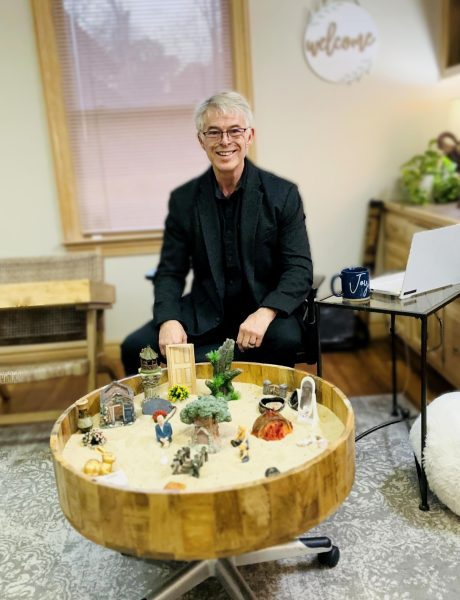
Dr. James L. Jackson, NCC, LPC-S, RPT™-S, Registered Sand Therapist – Consultant/Trainer

APT Approved Provider 26-812
Foundations of Sandtray Play Therapy II
The Role of the Witness
Saturday, July 25th, 2026
Location:
The Church at Brook Hills
3145 Brook Highland Pkwy, Conference Room 107, Birmingham, Alabama 35242
Dr. James L. Jackson, Ph.D, NCC, LPC-S, RPT™-S is solely responsible for all aspects of the program.
I have included a map (below) with directions to help you find your way. Parking for the training is Lot 13 on the map; Entrance 3 are the doors to enter the building closest to the training room, and the training session will be held in Community Room 7. If you have trouble finding us, please feel free to text or call 205.800.0215 and we’ll help guide you! We look forward to seeing you Saturday!
James
Program Registration Requirements:
Program participants can register for the training at the link by clicking Here
Program Content Description:
This play therapy workshop will focus on the Four Healing Messages proposed by Garry Landreth – I am Here, I Hear You, I Understand, and I Care – and how these may be facilitated in a sand tray play therapy session through nonverbal Witnessing.
Experiencing “I am Here” as a Nervous System Anchor: We will practice witnessing sand tray play therapy without an “agenda” (Landreth, 2012) and explore how this acts to contain client work (Cunningham, 2013) and promote regulation (Siegel, 2010).
Communicate “I Hear You” Through the Somatic Field: Open, right-brain attention helps track clients’ nonverbal and sensory experiences without judgment (McGilchrist, 2009). Participants will practice tuning in to their own bodily reactions (somatic countertransference) to connect with clients’ unspoken, subcortical emotional states (Cunningham, 2011).
Attuning with “I Understand” to Build Containment: Intense right-hemisphere-to-right-hemisphere attunement (Schore, 2019) is a foundation for therapeutic understanding. Honoring the psyche can help integrate client inner worlds (Badenoch, 2017).
Demonstrating “I Care” to foster creative Flow: The felt experience of deep safety and non-possessive care can reduce left-hemisphere anxiety, promoting a safe, regulated space for self-consciousness (Csikszentmihalyi, 1990; Oaklander, 2006) supporting relational containment where clients can enter a liminal, restorative flow state where implicit trauma can be integrated.
Additionally, this workshop will provide participants a review of the origins of Sandtray play therapy, examine significant interpersonal neurobiological frameworks from which to view the sand tray play therapy process, and practice Sandtray therapy witnessing skills that can help facilitate clients’ therapy using sand trays as well as elements of play therapy.
Learning Objectives:
Program participants will:
1. Demonstrate comprehension of relational neuroscience research related to the foundations of sand tray play therapy and the four basic play therapy healing messages vital for effectively engaging diverse clients in sand tray play therapy sessions.
2. Apply play therapy skills through the role of Witness in Sandtray play therapy that contribute to clients experiencing the healing message from the therapist “I am here.”
3. Analyze how the therapist role of Witness in Sandtray play therapy contributes to the client experiencing the healing message from the therapist “I hear you.”
4. Synthesize aspects of the therapist role of Witness in Sandtray play therapy that contribute to clients experiencing the healing message from the therapist “I understand.”
5. Evaluate how the therapist role of Witness in Sandtray play therapy contributes to the client experiencing the healing message from the therapist “I care.”
6. Engage in guided practice for deepening the play therapy experience of play therapist in the role of Witness through guided practice and reflective feedback.
Schedule
| Registration | 8:30-9:00 |
| Workshop Session I 1. Demonstrate comprehension of the relational neuroscience research regarding foundations of sand tray play therapy and the four basic play therapy healing messages vital for effectively engaging diverse clients in sand tray play therapy sessions. | 9:00-10:30 |
| Morning Break | 10:30-10:45 |
| Workshop Session II 2. Apply play therapy skills through the role of Witness in Sandtray play therapy that contribute to clients experiencing the healing message from the therapist “I am here.” 3. Analyze how the therapist role of Witness in Sandtray play therapy contributes to the client experiencing the healing message from the therapist “I hear you.” | 10:45-12:15 |
| Lunch On Your Own | 12:15-1:30 |
| Workshop Session III 4. Synthesize aspects of the therapist role of Witness in Sandtray play therapy that contribute to clients experiencing the healing message from the therapist “I understand.” 5. Evaluate how the therapist role of Witness in Sandtray play therapy contributes to the client experiencing the healing message from the therapist “I care.” | 1:30-3:00 |
| Afternoon Break | 3:00-3:15 |
| Workshop Session IV 6. Engage in guided practice for deepening the play therapy experience of play therapist in the role of Witness through guided practice and reflective feedback. | 3:15-4:45 |
All times are CST
Continuing Education Credit
Six Contact Hours will be awarded for a full day of attendance.
Registration Fees
| REGISTRATION FEES | Registration Dates |
| ALC/LPC/LMFT | $75.00 |
| Graduate Counseling Student with Student ID Card | Scholarships Available |
| Light Snacks will be provided! |
Space is not Guaranteed Until Your Registration is Processed.
References, Citations, and Research Used to Support the Presentation
References
Badenoch, B. (2008). Being a brain-wise therapist: A practical guide to interpersonal neurobiology. W. W. Norton & Company.
Badenoch, B. (2017). The heart of trauma: Healing the embodied brain in the context of relationships. W. W. Norton & Company.
Boyer, R. (1970). The Lowenfeld world technique. Pergamon Press.
Csikszentmihalyi, M. (1990). Flow: The psychology of optimal experience. Harper & Row.
Cunningham, L. (2011). Countertransference in sandplay: The heart and the mind of a loving, attuned other. Journal of Sandplay Therapy, 20(1), 7–21.
Cunningham, L. (2013). Sandplay and the clinical relationship. Sempervirens Press.
Hartwig, E. K., & Bennett, M. M. (2017). Four approaches to using sandtray in play therapy supervision. International Journal of Play Therapy, 26(4), 230–238. https://doi.org/10.1037/pla0000050
Homeyer, L. E., & Sweeney, D. S. (2011). Sandtray therapy: A practical manual (2nd ed.). Routledge.
Kalff, D. M. (2020). Sandplay: A psychotherapeutic approach to the psyche. Analytical Psychology Press.
Kestly, T. A. (2014). The interpersonal neurobiology of play: Brain-building interventions for emotional well-being. W. W. Norton & Company.
Kottman, T. (2023). Adlerian applications of sandtray play therapy. World Journal for Sand Therapy Practice®, 1(3).
Landreth, G. L. (2012). Play therapy: The art of the relationship (3rd ed.). Routledge.
Lowenfeld, M. (1979). The world technique. George Allen & Unwin.
Lowenfeld, M. (1993). Understanding children’s sandplay: Lowenfeld’s world technique. Cambridge University Press.
McGilchrist, I. (2009). The master and his emissary: The divided brain and the making of the Western world. Yale University Press.
Mitchell, R. R., & Friedman, H. S. (1992). Sandplay: Overview of the first sixty years. Journal of Sandplay Therapy, 1(2).
Ramsey, L. C. (2014). Windows and bridges of sand: Cross-cultural counseling using sand tray methods. Procedia – Social and Behavioral Sciences, 159, 541–545. https://doi.org/10.1016/j.sbspro.2014.12.421
Roesler, C. (2019). Sandplay therapy: An overview of theory, applications and evidence base. The Arts in Psychotherapy, 64, 84–94. https://doi.org/10.1016/j.aip.2019.04.001
Schore, A. N., Siegel, D. J., & Cozolino, L. (Eds.). (2021). Interpersonal neurobiology and clinical practice. W. W. Norton & Company.
Timm, N. M. A., & Garza, Y. (2017). Beyond the miniatures: Using Gestalt theory in sandtray processing. Gestalt Review, 21(1), 44–55.
Location
Special Needs
Please contact CE & Registration at Dr.JJ.LPC@Gmail.com Registration & CE Coordinator
Cancellations
Registrants canceling up to 48 hours before a workshop will receive a tuition refund less a $20 administrative fee. All requests must be made in writing or by email. No refunds will be issued for any reason on the day of the event. In the unlikely event the workshop cannot be held, registrants will receive a full refund.
Statement of Ethical and Legal Compliance
The provider, Dr. James L. Jackson, is committed to conducting all educational and business activities with integrity, professionalism, and transparency. All operations are carried out in a responsible, lawful, and ethical manner, in compliance with local, state, and federal laws and regulations. This commitment includes upholding the highest standards of ethical accountability and best practices within a culture of respect and fairness, and ensuring that all practices meet or exceed legal and ethical requirements.
2. The provider will offer the program in a manner that is compliant with all federal, state, and local laws, including the requirements of the Americans with Disabilities Act (ADA).
ADA Accommodations
We comply with the Americans with Disabilities Act (ADA) and are committed to providing accessible programming.
- Requesting Accommodations:
Participants with disabilities may request reasonable accommodations by contacting Dr. James L. Jackson at Dr.JJ.LPC@Gmail.com at least 14 days before the date of the program. - Available Accommodations May Include:
- Enlarged materials or digital formats
- Reserved seating
- Extended test-taking time for post-tests (where applicable)
- Screen-reader–friendly materials
- Confidentiality:
All disability-related information and accommodation requests are handled with strict confidentiality.
3. The provider maintains policies concerning program fees, refunds, and participant cancellation.
3.A.) Program Fees
- Fee Structure:
Each program’s registration fee is clearly stated on its promotional materials and registration platform. Fees vary by format, duration, and CE hours. - Included in the Fee:
- Instructional content
- Learning materials (digital or print)
- CE Certificate (upon completion)
- Access to online platforms (if applicable)
- Payment Methods:
Full payment is required at the time of registration. Accepted methods include credit/debit cards and electronic payment systems. Group billing may be arranged upon request.
3.B.) Refund Policy
- Full Refund:
Cancellations made 14 or more days prior to the program receive a full refund minus a $25 administrative fee. - Partial Refund:
Cancellations made 7–13 days before the start date are eligible for a 50% refund. - No Refund:
Cancellations made within 6 days of the program, or no-shows, are not eligible for a refund. - Processing:
Refunds are processed within 10 business days via the original payment method.
3.C.) Participant Cancellation Policy
- Cancellation Requests:
Must be submitted in writing via email to Dr. James L. Jackson at Dr.JJ.LPC@Gmail.com. The timestamp of the email determines refund eligibility. - Substitutions:
A registrant may transfer their spot to another participant at no cost, up to 3 business days before the program. - Transfer of Credit:
Requests to transfer registration to a future offering of the same course must be made at least 7 days prior to the original program date. - Emergency Exceptions:
Requests for exceptions due to medical or family emergencies may be reviewed individually. Documentation may be required.
3.D.) Provider-Initiated Cancellation or Rescheduling
- Notice:
If a program is canceled or rescheduled due to low enrollment, instructor unavailability, or force majeure, participants will be notified promptly by email and/or phone. - Options:
Participants may choose between:
- A full refund, or
- A credit toward a future or alternate course
4. The provider maintains a published policy concerning the review and resolution of program participant complaints and disputes related to provider programs.
Review and Resolution of Participant Complaints and Dispute Policy
We are committed to maintaining safe, respectful, and professionally-enriching experiences for all participants.
- Filing a Complaint:
Concerns regarding course content, delivery, instructor behavior, or administrative policies should be submitted in writing to Dr. James L. Jackson at Dr.JJ.LPC@Gmail.com. - Resolution Process:
All complaints are reviewed by the CE Director or appointed designee. A written response will be provided within 10 business days of receipt. - Further Action:
If the matter is unresolved, participants may escalate the complaint to the NBCC accrediting organization.
Verifying participant attendance:
Attendance Requirements
- Full Participation
- Participants must be present for 100% of the scheduled instructional time to receive credit.
- Any absence, late arrival, or early departure beyond the allowed grace period may result in forfeiture of credit.
- Minimum Seat Time
- A minimum attendance threshold of 100% of the event duration is required
Tracking Attendance
In-Person Events
- Sign-In/Sign-Out Logs: Participants must sign in on the official log sheet at the start and sign out at the end of each segment of the event for which Continuing Education is being earned. The log sheet will include at a minimum the following information:
- Participant Name, Date, Licensure information including State and Identification Number, Educational Credentials, Relevant Specialty Credentials, Time In/Time Out to be signed for each segment of the event.
- Timed Checkpoints: random attendance checks during sessions.
Provider procedure for distributing certificates of completion within a timely manner:
Certificate Distribution and Replacement Policy
- Standard Delivery:
CE Certificates are distributed electronically upon successful completion of course requirements (including evidence of full attendance, completion of program survey, and post-test completion). - Lost or Missing Certificate:
Participants who need a certificate reissued must submit a written request to DR. James L. Jackson at Dr.JJ.LPC@Gmail.com. - Replacement Fee:
A $10 administrative fee may be charged for duplicate or replacement certificates issued more than 30 days after the program date. - Delivery Method:
Certificates will be issued and reissued in PDF format via email unless otherwise requested.
Contact Information
For all questions regarding registration, cancellation, accommodations, or policies, please contact:
Dr. James L. Jackson, NCC, LPC-S, RPT-S
Dr.JJ.LPC@gmail.com
205.800.0215
5147 Colonial Park Rd
Birmingham, Alabama 35242
Timely Review of Programs:
Dr. James Jackson will serve in the capacity of both reviewer and
presenter of programs. As the Program Reviewer, Dr. James Jackson will require the Approved Provider of training to submit all trainings for approval by the Program Reviewer a minimum of thirty (30) days PRIOR to
any marketing and advertising efforts. This will ensure that program continuity is maintained throughout the process and will also serve to reinforce the “Golden Thread” approach, and also provide the Program
Reviewer an opportunity to thoroughly analyze the content and quality of the play therapy training being offered so that any required changes can be made in a timely manner by the Approved Provider prior to the presentation date.
Presenter Expertise: Dr. James L. Jackson, Jr., Ph.D., LPC-S, NCC, Registered Play Therapist – Supervisor, is a Professor of Counseling and Clinical Mental Health Counseling program coordinator at the university level and an outpatient therapist at Indian Springs Counseling and Wellness in
Birmingham, Alabama. James has 25 years experience providing play therapy with children, adolescents, and adults through both office-based and
in-home services. James’ clinical experience include utilizing Child Centered Play Therapy and Sandtray Therapy in Child Advocacy Centers and foster homes, group homes, and outpatient facilities, and his public school experiences include teaching children in grades pre-K – 12 in rural Tennessee as well as teaching and supervising graduate counseling students in Alabama, Colorado, and in Texas on the U.S./Mexico border.
These experiences have provided Dr. Jackson with rich opportunities to develop and integrate cultural and social diversity-informed practices in his teaching, and he has worked with developing standards for the Counselors for Social Justice division of the ACA, and has taught Multicultural Counseling coursework and seminars. Dr. Jackson’s responsibilities as a professor in colleges of education have included developing graduate counseling coursework that presents information that is accurate and empirically-validated, and respects the intellectual property rights of
content developers and the use of copyrighted materials.
Dr. Jackson will declare any conflicts of interest, competing interests, or commercial support that exist for any CE program being presented, including his roles as the individual provider acting as presenter, reviewer and administrator of the program, and will refrain from using training as a promotional opportunity. Dr. Jackson integrates play therapy in his
educational, supervisory, and clinical work, and is a member of the Association for Play Therapy and the Alabama Association for Play Therapy.
Instructional methods: Instructional methods utilized in programs will be based on Dr. Jackson’s 30 years of teaching experience, including experiences developing and teaching Introductory and Advanced Play Therapy coursework and graduate-level coursework. Instructional methods will include both psychoeducational discussion of structural frameworks of theoretical concepts (Knowledge, Comprehension areas of Bloom’s Taxonomy of Cognitive Objectives) as well as Application, Analysis, Synthesis, and Evaluation opportunities through guided practice. Audio/Video recordings, group discussion, lecture, and experiential activities and processing will be implemented.
Post test: For all programs that are not delivered in a face-to-face format, assessment will be directly related to the program objectives and will assess attendee mastery of cognitive objectives at the knowledge, comprehension, application, and assessment, synthesis, and evaluation levels of the material and experiences provided during the program using Bloom’s Taxonomy of Cognitive Objectives. Post testing will be conducted with respect for confidential and sensitive information and materials, and will be required for all non-contact programs, including webinars, to ensure participants performed all work for which credit is awarded. Post tests will be of sufficient depth to measure both applied and conceptual knowledge
Program materials: Examples will include PowerPoint presentations, video examples, play therapy creative materials, sand tray containers, sand, and miniatures for use in experiential activities.
- Evaluation –
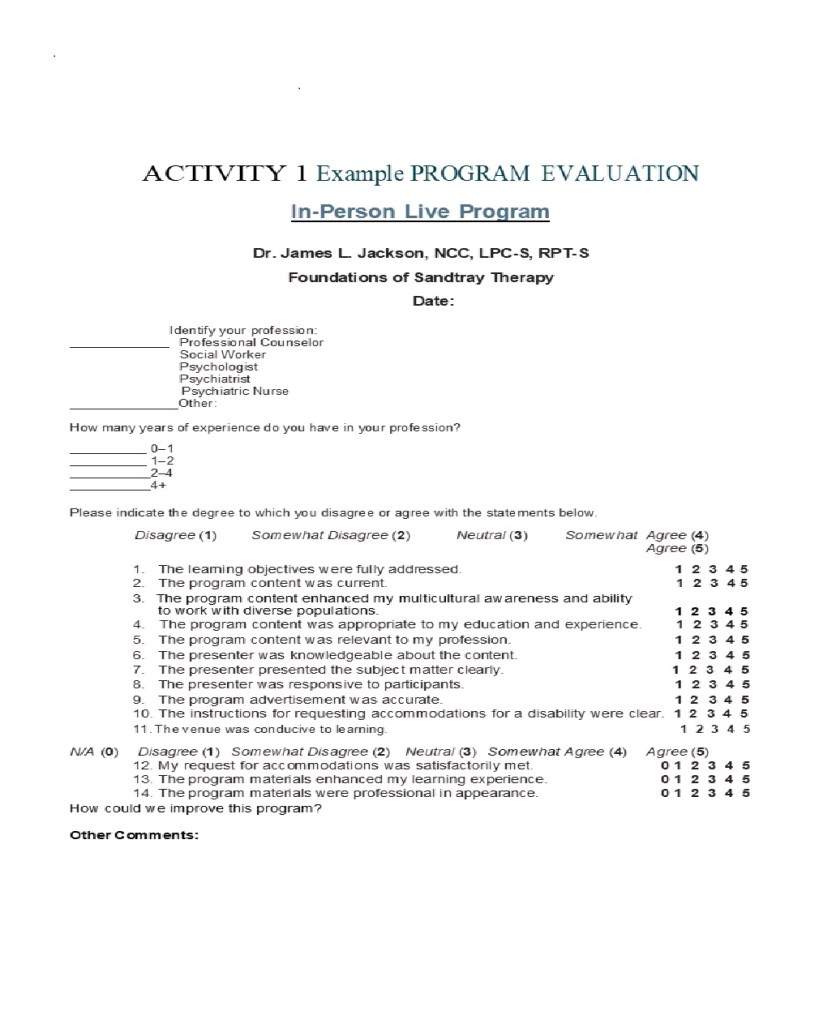
Program Evaluation
Approved Providers employ a program evaluation for the purpose of improving program development
and implementation, the selection of instructors, and delivery methods.
The evaluation of CE programs must: - evaluate how well each educational objective was achieved,
- collect attendee feedback specific to presenter knowledge and delivery of information,
- assess the utility and limitations of the content being presented.
Describe the evaluative mechanism and process in place you use and how this information is used to
inform program planning (e.g., strengthen future programs).
The Evaluation Instrument will be administered to all attendees at the end of the training program schedule as a culminating activity of the training. Attendees will be required to complete the evaluation and then present the completed evaluation to the Approved Provider in order to receive a certificate of continuing education.
The Evaluation Instrument will be used to identify ongoing opportunities for program improvement, including 1.) how well each educational objective was achieved, 2.) attendee feedback specific to presenter knowledge and delivery of program information, and 3.) assess the usefulness and limitations of the presented content.
A Sample Evaluation Instrument is located below:
Records will be maintained according to the double-lock guideline for confidentiality of physical files and electronic storage drives.
Program documentation will include dates of program presentations and maintained on an Excel spreadsheet. The Annual Activity Report document will be scheduled in the Program Presentation calendar to ensure compliance with submission dates.
The following basic information will be maintained for a minimum of five (5) years:
a. program title, learning objectives, and content description,
b. program presenter’s names, highest mental health degrees, and primary mental health credentials,
c. program date(s), facility name and address, city, and state,
d. summary of attendee’s program evaluations,
e. number of play therapy continuing education hours earned by attendees,
f. a list of program attendees who earned certificates of attendance, and
g. references, citations, and research used to support the presentation.
h. Continuing Education Certificates (Certificates of Attendance), including:
- attendee name,
- event or program name,
- name and credentials of presenter(s),
- sponsor and, if applicable, co-sponsor name(s),
- date(s),
- city and state,
- number of play therapy credit hours awarded (one [1] hour credit = 60 minutes),
- indicated credit hours as either contact (in person) or non-contact training,
- APT Approved Provider 26-812 (mandatory phrase), and
- if issuing one certificate for multiple trainings, list the title, date, presenter(s), and number of hours for each training on the certificate.
All records will be available for audit upon request by the Association for Play Therapy.
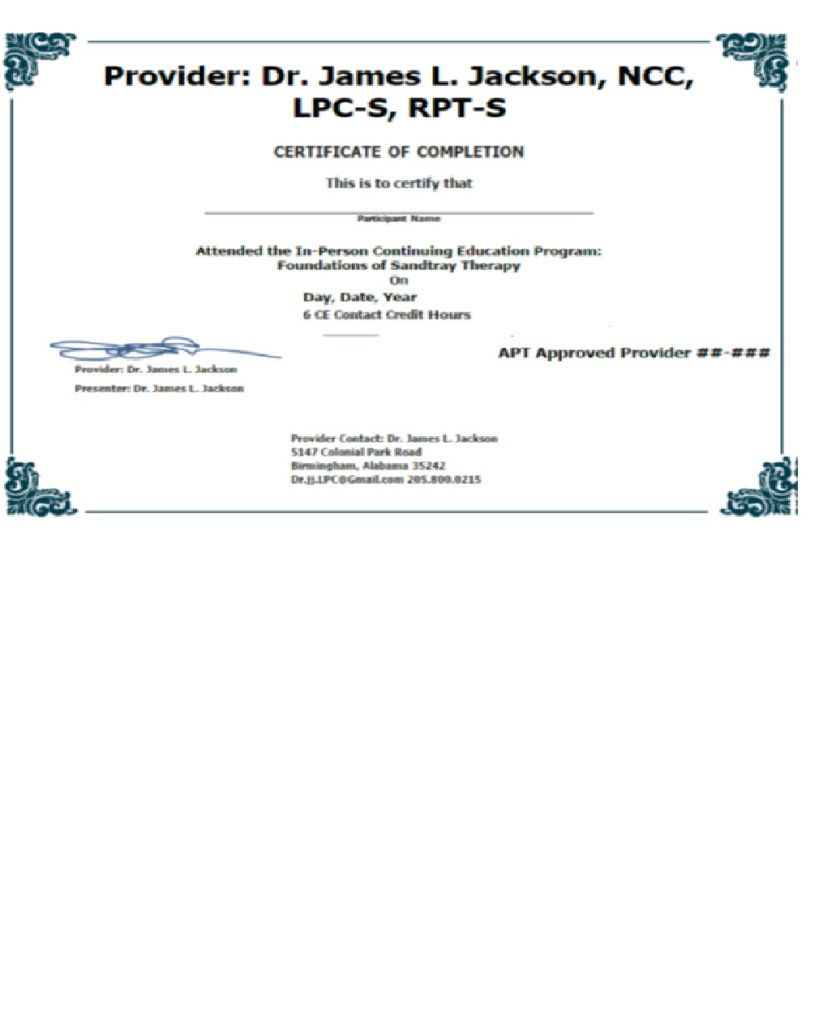
Sample Certificate: